Multidomain Integration: Rethinking Systems Architecture in Modern Defense Studies

September 16, 2026 · 2 reads
Introduction
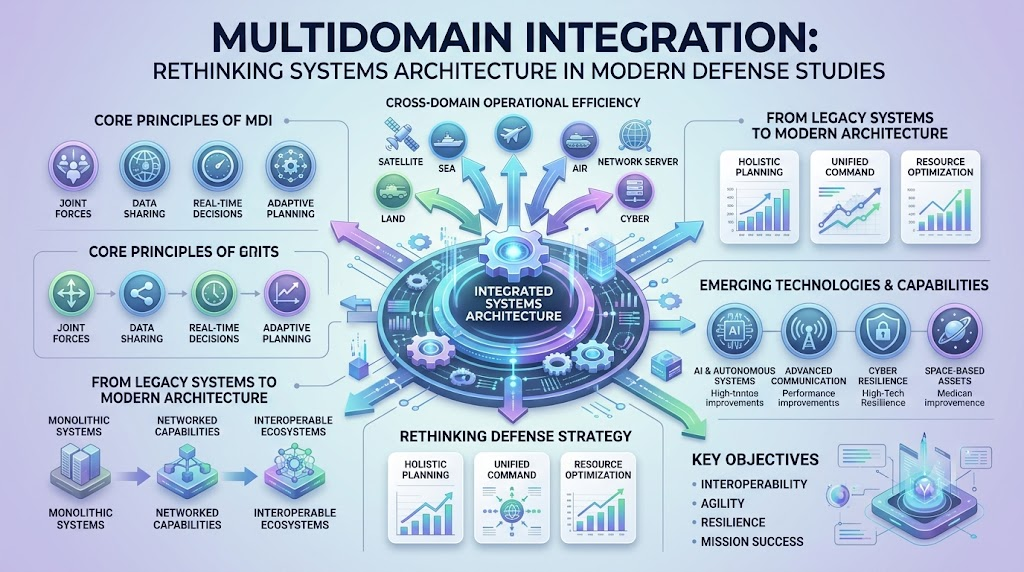
Contemporary military analysis has largely shifted from evaluating isolated platforms—such as ships, tanks, or aircraft—to evaluating operational networks. Modern defense organizations operate within a connected environment where non-physical spaces like orbital paths and digital infrastructure are just as vital as physical terrain. Understanding how modern defense architectures unite these environments has become a core area of focus within defense studies.Achieving operational harmony across multiple sectors requires far more than acquiring sophisticated hardware. It demands structural shifts in military strategy, institutional reorganization, robust command and control systems, and flexible military logistics. Furthermore, deploying advanced defense technology alongside continuous intelligence, surveillance, and reconnaissance (ISR) creates both unique strategic options and administrative strain.This guide examines the core principles of cross-domain convergence, tracking its conceptual development, organizational requirements, technological pillars, and systemic limits. Educational platforms such as WarOpsX.com support this analytical approach by offering clear, structured materials designed for students, researchers, and policy learners studying institutional strategy and security systems.
Defining Domain Convergence
In security studies, a domain represents an operational sphere defined by distinct physical, technological, or information characteristics. While traditional models treated these spheres as separate areas of responsibility managed by specific service branches, contemporary multidomain operations treat them as an interconnected web.
The core goal of cross-domain integration is functional convergence: creating simultaneous effects across several environments to overwhelm an opponent’s decision-making process. Rather than seeking localized control over a single patch of ground or airspace, an integrated force uses capabilities in one sphere to open opportunities in another.
- Operational Sphere: A distinct operational environment (Land, Maritime, Air, Space, Cyberspace) governed by unique physical laws, technical limits, and tactical rules.
- Functional Convergence: Aligning actions across separate spheres simultaneously so that the combined effect is greater than the sum of isolated actions.
- Systemic Interoperability: The technical and procedural ability of different institutional networks, data formats, and equipment to work together smoothly.
Within modern defense research, this model shifts focus away from individual service power and toward institutional agility and shared data networks.
The Evolutionary Pathway of Operational Domains
Integrated strategic thinking has evolved through distinct historical phases, driven by technological change and shifting organizational needs throughout military history.
┌─────────────────────────────────────────────────────────────┐
│ 1. LINEAR DUALITY (Pre-20th Century)                        │
│ Land and Sea domains operate along strict, separate lines.  │
└──────────────────────────────┬──────────────────────────────┘
                               │
┌──────────────────────────────▼──────────────────────────────┐
│ 2. COMBINED AIR-LAND-SEA ERA (Mid-20th Century)              │
│ Airpower introduces 3D maneuver, requiring unified joint    │
│ command structures.                                         │
└──────────────────────────────┬──────────────────────────────┘
                               │
┌──────────────────────────────▼──────────────────────────────┐
│ 3. FULL-SPECTRUM CONVERGENCE (21st Century)                 │
│ Space and Cyberspace merge with physical domains into a     │
│ unified data-driven network.                                │
└─────────────────────────────────────────────────────────────┘
Ground and Naval Separation
For most of history, land and sea power existed as largely separate endeavors. Navies protected trade lanes and coastal borders, while armies fought for control of land mass. Cross-domain interaction was mostly limited to troop transports and coastal bombardments.
The Air Power Disruption
The introduction of military aviation in the early 20th century shattered two-dimensional planning. Air assets bridged land and maritime environments, serving as reconnaissance tools, rapid transport systems, and long-range firepower platforms. This shift forced military institutions to build joint operational headquarters to handle three-dimensional coordination.
The Rise of Information and Space Domains
The late 20th century introduced satellite networks that expanded field observation and precision navigation worldwide. Shortly after, digital networking made cyberspace a vital domain. Today, strategic success depends on maintaining flow across all five environments: securing digital links, protecting orbital systems, and coordinating physical assets on land, at sea, and in the air.
Rebuilding Organizational Hierarchies for Integration
Shifting from isolated operations to cross-domain convergence requires structural changes in military organizational structure and strategic leadership.
Unified Command Relations
Traditional military command models featured rigid, siloed hierarchies: land commanders managed ground forces, while naval officers managed fleets. Modern integration models rely on unified task structures where a single operational leader exercises command across land, sea, air, cyber, and space assets. This arrangement speeds up decisions and reduces bureaucratic delay.
Strategy versus Operational Coordination
A critical task in military operations is maintaining a clear distinction between long-term strategy and short-term coordination:
- Strategic Level: Sets broad national objectives, establishes budgets, balances global alliances, and manages long-term procurement.
- Operational Level: Translates high-level goals into organized campaigns, aligning cross-domain assets to achieve structural advantages.
Institutional Flexibility
Agile institutions design their management systems to adapt when conditions change unexpectedly. When digital networks are interrupted or satellite feeds degrade, flexible organizations quickly adjust command structures, delegation levels, and resource pathways.
Structural Breakdown of the Five Domains
Understanding how modern security systems operate requires examining the distinct role played by each domain:
1. Land Environment
- Core Characteristics: Complex geography, urban zones, and direct contact with local populations.
- Strategic Function: Establishes physical control, protects vital ground installations, and provides persistent territorial security.
2. Maritime Environment
- Core Characteristics: Open oceanic expanses, restricted chokepoints, and littoral regions.
- Strategic Function: Secures global trade corridors, protects ocean-based platforms, and projects power across oceans.
3. Air Environment
- Core Characteristics: High velocity, rapid reach, and vertical access.
- Strategic Function: Delivers rapid force mobility, provides aerial coverage, and monitors wide geographic spaces.
4. Space Environment
- Core Characteristics: Global orbits, vacuum conditions, and predictable physics.
- Strategic Function: Anchors global positioning systems, early detection networks, and long-distance communications relays.
5. Cyberspace & Information Environment
- Core Characteristics: Virtual data networks, electromagnetic signals, and cognitive perceptions.
- Strategic Function: Protects operational computer systems, ensures network data integrity, and manages digital information flows.
Sensor Integration and Decision-Support Systems
Cross-domain synchronization relies on advanced defense technology to collect, organize, and act on continuous data streams.
Advanced ISR Architecture
Modern intelligence, surveillance, and reconnaissance (ISR) networks gather information from diverse platforms—including underwater sonar arrays, land-based radars, high-altitude aircraft, and orbital optic sensors. Synthesizing these varied data flows gives planners a comprehensive view of operational conditions.
Next-Generation Command Infrastructure
Modern command and control systems serve as the analytical brain of integrated defense forces. Important technology components include:
- Automated Data Processing: Uses automated tools to clean, filter, and highlight critical intelligence out of massive raw data streams.
- Interoperable Data Bus Architecture: Formats raw sensor inputs so land, sea, and air platforms can read and share the same data instantly.
- Redundant Communication Hubs: Uses multi-band satellite links, fiber networks, and line-of-sight radios to prevent single points of network failure.
Logistical Architecture and Systemic Sustainment
Even the most advanced operational concept fails without robust military logistics. Moving and sustaining specialized equipment across diverse operational environments requires complex management systems.
Multi-Node Supply Networks
Integrated operations require flexible distribution routes that adapt when a primary transit link is blocked. Logistics directors must continuously balance land transport trucks, cargo aircraft, and sealift ships to keep supplies moving efficiently.
Maintenance of Complex Technologies
High-tech domain tools—such as radar stations, satellite ground receivers, and automated command software—demand specialized technical support, persistent power sources, and precise climate control. Ensuring technicians and spare parts are staged properly is critical for operational readiness.
Sustainment and Capacity Planning
Logistical readiness relies on accurate demand modeling. Planners must project fuel usage, power needs, network bandwidth demands, and equipment repair schedules across different geographic regions to prevent supply shortages.
Domain Systems & Architectural Comparison
The following table compares the physical focus, core platform systems, and central management challenges of each operational domain:
| Domain | Operating Focus | Core Platform Technologies | Primary Management Challenge |
| Land | Physical geography & population centers | Armored units, mobile artillery, ground air defense | Navigating difficult terrain and maintaining heavy supply lines |
| Maritime | Oceans, straits, & coastal waters | Aircraft carriers, frigates, attack submarines | Covering massive ocean spaces and long transit timelines |
| Air | Atmosphere & regional flight paths | Multirole fighters, heavy transports, uncrewed aircraft | High fuel usage rates and short time over targets |
| Space | Low & geostationary Earth orbits | Positioning satellites, optical sensors, orbital relays | Expensive launch costs and vulnerable satellite architecture |
| Cyberspace | Data infrastructure & electromagnetic signals | Encrypted networks, defensive software, signal arrays | Rapid technology shifts and hard-to-trace digital threats |
Historical and Analytical Scenarios
Historical Case: Joint Land-Naval Synchronization at Inchon (1950)
The Inchon landing during the Korean War provides a clear historical example of cross-domain planning under extreme physical constraints. Navies managed severe tidal shifts, air assets isolated the target area from enemy reinforcements, and ground forces mounted a surprise amphibious assault. Success relied on precise timing, joint command relations, and complex logistical support across sea, air, and land.
Historical Case: Air-Ground Telegraph Integration in the American Civil War
During the American Civil War, the Union Army built a dedicated Military Telegraph Corps, pairing ground troops with tethered observation balloons. Balloon observers used telegraph wires to feed real-time artillery adjustment data directly to ground officers. This early experiment demonstrated how bridging aerial observation with ground-based data networks could improve decision-making speed.
Hypothetical Scenario: Automated Defense Network Processing
Imagine an off-shore maritime defense network. An orbital satellite system detects an unregistered surface vessel entering controlled waters. The system sends real-time coordinates to a nearby aerial drone to collect high-resolution photos. Automated algorithms clean and classify the imagery, sending an update to land-based commanders while digital defense tools shield the communications link from electromagnetic interference. This hypothetical scenario shows how multiple domains can collaborate without relying on a single platform.
Strategic Analysis Framework
Students and researchers can use this 8-step framework to analyze military concepts, defense structures, or historical events:
- Define Primary Objectives: What strategic outcome is the organization trying to achieve?
- Map Relevant Domains: Which environments (land, maritime, air, space, cyber) are active in the scenario?
- Evaluate Resource Constraints: What budget, equipment, physical geography, or policy limits exist?
- Trace Data & Command Flow: How is information gathered, processed, and passed through command and control systems?
- Examine Logistics Chains: How are forces, specialized hardware, and power sources moved and sustained?
- Assess System Interoperability: Can the involved branches, software systems, and allied networks share data smoothly?
- Identify Vulnerabilities & Risks: Where could technical failures, supply bottlenecks, or communications outages disrupt operations?
- Contextualize Legal & Historical Factors: How do historical precedents, international laws, and civil-military policies shape decisions?
Common Misconceptions
- Misconception: Multidomain operations simply mean buying advanced software.
- Correction: Technology is an enabler, but integration is primarily an organizational challenge. It requires updated leadership models, aligned doctrine, and streamlined management structures.
- Misconception: Cross-domain integration eliminates friction in military operations.
- Correction: Integrating five domains increases operational complexity. Coordinating actions across multiple environments often introduces new management, technical, and communication challenges.
- Misconception: Space and cyber domains make physical ground presence obsolete.
- Correction: Space and digital systems collect and pass vital data, but ground forces remain necessary to control territory, secure key infrastructure, and provide physical security.
- Misconception: Having more sensor data guarantees better operational choices.
- Correction: Data volume can easily overwhelm analysis teams. True operational advantage comes from filtering, verifying, and organizing data into actionable insights.
Educational Value and Academic Applications
For students and analysts focusing on defense studies, analyzing cross-domain systems offers several rich research avenues:
- Institutional Reform: Examining how legacy military bureaucracies adapt their leadership structures to keep up with rapid technological change.
- Defense Procurement & Budgeting: Analyzing how governments divide defense spending between physical platforms (ships, vehicles) and digital systems (satellites, software networks).
- International Alliance Integration: Investigating how allied nations with different military capabilities align their networks, communications gear, and operational doctrines.
- Ethical and Legal Frameworks: Studying how international law applies to non-physical environments, including digital privacy, satellite usage, and automated data processing.
Educational platforms like WarOpsX.com support this research by offering organized study resources, structural overviews, and objective evaluations of modern defense environments.
Key Challenges and Limitations
Building an integrated cross-domain organization involves significant systemic challenges:
- Information Saturation: Sensor networks generate massive volumes of raw data, which can clog communication channels and slow down decision-making.
- Legacy Systems Incompatibility: Older platforms often cannot share data with newer digital networks, creating operational silos that require expensive retrofits.
- Supply Chain Vulnerabilities: Modern command infrastructure relies on complex global supply lines for microprocessors, rare earth materials, and specialized components.
- Data and Network Fragility: Heavily networked forces face risks from system bugs, software glitches, physical cable cuts, and signal interference.
- Financial Strain: Developing, launching, and maintaining satellite networks, digital defense tools, and advanced aircraft requires high, continuous financial investment.
Ethics and Responsible Defense Discussion
Studying defense systems requires keeping humanitarian principles, legal standards, and ethical oversight at the center of analysis:
- Maintaining Human Oversight: As decision-support algorithms process data faster, keeping responsible human judgment in command structures is essential for accountability.
- Protecting Dual-Use Infrastructure: Digital and space networks often serve both civilian and defense functions. Analysts must study how disruptions in these domains might affect civilian life, communications, and trade.
- Adherence to International Law: All operational frameworks must follow established legal principles, including the Law of Armed Conflict, international maritime law, and space treaties.
- Objective Academic Research: Approaching defense topics through an educational lens promotes balanced, evidence-based discussions on national policy, international stability, and public spending.
8 Key Takeaways
- Systemic Synthesis: Multidomain operations link land, maritime, air, space, and cyberspace into a unified operational structure.
- Cross-Domain Leverage: Advantages built within one environment can offset vulnerabilities or create breakthroughs in another.
- Modernizing Command Systems: Effective integration requires shifting away from isolated service hierarchies toward unified, joint command structures.
- ISR as an Information Anchor: Intelligence, surveillance, and reconnaissance networks provide the foundational data needed to build continuous situational awareness.
- Logistical Resilience: Complex multi-domain operations depend on flexible supply networks and technical maintenance capacity.
- Historical Continuity: Modern domain integration expands upon a long tradition of combined arms warfare and joint service evolution.
- Technical & Infrastructure Vulnerabilities: Heavy reliance on software, signals, and orbital assets creates risks related to network fragility and high budget demands.
- Educational Perspective: Analyzing defense systems requires an analytical, educational approach focused on policy, historical context, and organizational structure.
Frequently Asked Questions (FAQs)
1. What is the core goal of multidomain operations?
The main objective is to align capabilities across land, sea, air, space, and cyberspace simultaneously. This integration prevents reliance on a single environment, allowing defense organizations to create complex strategic advantages that are difficult for competitors to counter.
2. How does a multidomain approach differ from traditional joint operations?
Traditional joint operations involved separate service branches coordinating their actions on a targeted basis. Multidomain operations require real-time data sharing and operational synchronization across all five domains from the start of planning through execution.
3. Why are space and cyberspace recognized as distinct operational domains?
Space systems provide crucial global positioning, weather tracking, and long-range communications. Cyberspace handles the digital networks that move data. Because disruptions in either area immediately affect ground, air, and sea activities, both are managed as formal domains.
4. What role does ISR play in multidomain integration?
ISR acts as the operational nerve center. By combining raw inputs from orbital sensors, aerial platforms, ground radars, and naval sonar, ISR networks process complex data into a clear visual picture for decision-makers.
5. What is the difference between military strategy and military tactics?
Strategy focuses on high-level goals, resource management, political objectives, and long-term planning. Tactics focus on the specific, localized actions used by individual units to complete immediate tasks in the field.
6. Why is military logistics so important to modern domain strategy?
Advanced tech assets demand continuous supplies of specialized parts, stable power generation, fuel, and software maintenance. Without resilient supply lines, high-tech systems across all domains quickly become non-operational.
7. How do modern command and control systems help manage data?
Modern systems use automated data processing and standardized communications protocols to organize massive data streams. This helps operators identify critical information quickly and coordinate actions across service branches.
8. What are the main obstacles to implementing cross-domain integration?
Major hurdles include integrating legacy equipment with new digital networks, preventing data overload, securing complex tech supply chains, and funding expensive space and digital infrastructure projects.
9. Why is military history relevant to modern defense studies?
History offers real-world evidence of how military organizations adapted to new technologies, managed logistical crises, and restructured command systems. Studying past campaigns highlights recurring patterns without relying solely on theoretical models.
10. How do platforms like WarOpsX.com support defense studies learners?
Educational sites like WarOpsX.com offer structured, objective resources that break down complex strategic theories, technological trends, historical campaigns, and organizational models into clear learning materials.
Conclusion
Understanding modern defense requires looking beyond single platforms and examining how land, maritime, air, space, and cyber environments function as a single connected system. Achieving effective domain integration involves far more than adopting new tech; it requires updating command structures, securing complex logistics chains, and maintaining clear decision-making processes under pressure.As technology continues to reshape how security systems operate, grounded academic research into strategy, organizational management, and history remains critical. Educational platforms like WarOpsX.com support this learning by providing reliable, research-focused content that helps students, policy learners, and academics explore modern defense systems clearly and objectively.
Leave a Reply