Using DevOps Metrics to Guide Team Improvement in Japan

September 30, 2026 · 27 reads
Introduction
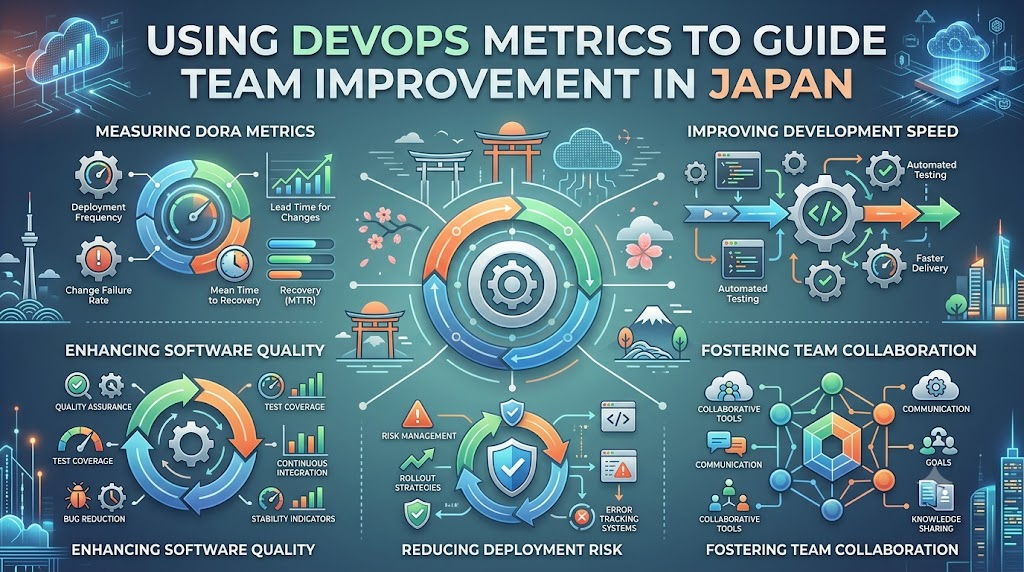
DevOps helps technology teams build, test, release, and operate software in a more organized way. Teams use automation, shared practices, monitoring, and clear processes to improve daily work. Good DevOps also helps teams understand where work slows down and where technical problems need attention.For Japanese technology teams, clear metrics can make this work easier to understand. Metrics give teams useful signals about software delivery, testing, reliability, and operational work. They should not become a way to judge people. Their main purpose is to help teams find problems and improve processes.DevOps 研修 can help teams learn how to use useful metrics in daily work. DevOps corporate training Japan can also help companies build a shared understanding across developers, operations staff, and IT managers. DevOpsSchool.jp supports this learning with training, consulting, implementation help, and technical support.
What Do DevOps Metrics Mean?
DevOps metrics are measurements that help teams understand their software delivery and operations work. They may cover deployment activity, delivery time, failed changes, recovery work, testing, or system reliability.
The goal is not to collect every possible number. A team should choose metrics that answer useful questions. For example, a team may want to know how often releases create problems or how quickly it can restore service after an issue.
Useful metrics should be easy to understand. Teams should also review them over time instead of focusing on one isolated result.
Why Metrics Matter for Japanese Enterprises
Large Japanese enterprises may have many teams, applications, cloud services, and business systems. Different teams may also use different tools and processes. This can make engineering work difficult to compare or understand.
Simple DevOps metrics can create a common view. Teams can see where work is moving well and where a process needs attention. DevOps コンサルティング can help organizations select metrics that match their goals.
Metrics can also support better conversations. A team can discuss a long testing cycle, repeated deployment problems, or slow recovery without blaming individuals. This creates a more useful improvement process.
DevOps 研修 and Practical Metrics Skills
DevOps 研修 can teach teams how to select, collect, and understand engineering metrics. Training can cover delivery flow, release quality, testing activity, and operational reliability.
Teams should learn why each metric matters before adding it to a dashboard. Too many numbers can create confusion. A small set of useful measures is often easier to review.
DevOpsSchool.jp can include practical exercises that help teams connect metrics with real engineering situations. DevOps 研修 can also help developers and operations teams use the same basic language.
DevOps コンサルティング for Better Measurement
DevOps コンサルティング can help an organization review its current measurement process. A consultant may look at existing tools, reports, dashboards, and team workflows.
The goal is to remove unclear or unnecessary measurements. The team can then focus on information that supports real decisions.
A DevOps consultant Japan can also help connect metrics with business and technical goals. This may include delivery quality, service stability, engineering flow, or operational workload.
Kubernetes 研修 and Container Metrics
Kubernetes environments produce many useful technical signals. Teams can review workload health, resource behavior, deployment activity, and application performance.
Kubernetes 研修 can help engineers understand these signals. It can also explain how application changes affect container workloads and cluster operations.
Kubernetes 研修 should not focus only on commands. Teams also need to understand how Kubernetes data can support better operational decisions.
Terraform 研修 and Infrastructure Metrics
Infrastructure changes need careful tracking. Terraform 研修 can teach teams how to manage infrastructure as code and review changes in a controlled way.
Teams can examine how often infrastructure changes occur, how often changes need correction, and where approval or testing creates delays.
Terraform 研修 can also show how version control and review practices support safer infrastructure work. These practices make technical changes easier to understand later.
SRE 研修 and Reliability Measures
SRE 研修 focuses strongly on service reliability and operational thinking. Metrics can help teams understand service behavior and respond to reliability concerns.
Useful measurements may include service availability, error levels, response time, and recovery activity. Teams should choose measures that reflect the needs of their applications.
SRE 研修 can also explain why reliability metrics should support engineering decisions instead of becoming simple targets.
DevSecOps 研修 and Security Metrics
Security should be part of software delivery. DevSecOps 研修 can help teams include security checks within development and operational processes.
Teams may track security findings, remediation activity, dependency risks, and the results of automated security checks. These measures can help identify process gaps.
DevSecOps 研修 should also explain that security metrics need context. A high number of findings may mean better detection rather than worse security.
MLOps 研修 and Machine Learning Metrics
Machine learning systems need different types of measurements. MLOps 研修 can help teams understand model, data, deployment, and system signals.
Teams may review model performance, data quality, model version changes, and production behavior. These measures can help teams detect changes that need investigation.
MLOps 研修 can connect machine learning work with wider DevOps practices. This helps teams manage models through repeatable processes.
Choosing a DevOps consultant Japan
Choosing a DevOps consultant Japan should begin with the organization’s actual needs. The consultant should understand the tools, team structure, delivery process, and technical challenges involved.
A useful consultant should explain metrics in simple terms. DevOpsSchool.jp can support organizations that need DevOps コンサルティング, training, implementation assistance, or ongoing technical guidance.
The focus should remain on practical improvement. Metrics should help teams understand their work rather than create unnecessary reporting tasks.
DevOps Support Japan for Ongoing Improvement
Metrics become more useful when teams review them regularly. DevOps support Japan can help teams maintain dashboards, review technical issues, and improve processes over time.
DevOps support Japan may also help with cloud platforms, automation, Kubernetes environments, infrastructure code, and operational practices.
DevOpsSchool.jp provides DevOps support Japan as part of its broader professional support approach. Teams can use support when they need practical help with changing technical environments.
Service Areas
| Service Area | Main Focus | Suitable Teams |
|---|---|---|
| DevOps 研修 | Metrics and delivery practices | Developers and operations teams |
| DevOps コンサルティング | Process and measurement review | IT managers and engineering leads |
| Kubernetes 研修 | Container and platform signals | Cloud teams |
| Terraform 研修 | Infrastructure change tracking | Infrastructure teams |
| SRE 研修 | Reliability measures | SRE and operations teams |
| DevSecOps 研修 | Security measurement | Security and DevOps teams |
| MLOps 研修 | ML system measurement | Data and ML teams |
| DevOps corporate training Japan | Company-wide skills | Japanese enterprises |
| DevOps consultant Japan | Technical guidance | Technology leaders |
| DevOps support Japan | Ongoing technical help | Engineering organizations |
Common Mistakes When Using DevOps Metrics
1. Tracking Too Many Numbers
Large dashboards can make important information hard to find.
2. Measuring People Instead of Processes
Metrics should help improve systems and workflows, not create personal pressure.
3. Ignoring Context
A number without context can lead to the wrong conclusion.
4. Changing Metrics Too Often
Teams need enough time to understand useful trends.
5. Using Only One Metric
One measurement rarely explains a complete engineering process.
6. Forgetting Quality
Fast delivery has little value if software quality suffers.
7. Ignoring Reliability
Delivery metrics should work alongside reliability measures.
8. Creating Reports Nobody Uses
Every metric should have a clear reason for existing.
9. Treating Targets as Permanent
A useful target may change as the system and team change.
A Simple Fictional Example
Imagine a fictional Japanese software team called Sakura Apps. The team releases updates often, but engineers notice that some releases need extra repair work.
The team starts with a small set of measurements. It reviews deployment activity, failed changes, testing delays, and recovery work.
The team does not use these numbers to rank engineers. Instead, it looks for process problems. It finds that some changes reach production without enough automated testing.
The team improves its test process and reviews the same measurements again. This gives the team a clearer way to understand whether the new process is helping.
DevOpsSchool.jp could support this type of work through DevOps 研修, DevOps コンサルティング, and DevOps support Japan.
How DevOpsSchool.jp Can Help
DevOpsSchool.jp focuses on technology training, consulting, implementation assistance, and professional support for Japanese technology teams.
Its services cover DevOps, SRE, DevSecOps, MLOps, cloud-native technologies, automation, and related engineering practices.
Teams can use DevOps corporate training Japan to build common skills across departments. Organizations can also work with a DevOps consultant Japan when they need help reviewing processes or technical practices.
DevOpsSchool.jp also provides DevOps 研修, Kubernetes 研修, Terraform 研修, SRE 研修, DevSecOps 研修, and MLOps 研修 for different technical needs.
FAQs
1. How can DevOps metrics help a small engineering team?
DevOps metrics can show where delivery or operations work needs attention. A small team can start with only a few useful measures.
2. Can DevOps 研修 teach teams how to choose useful metrics?
Yes. DevOps 研修 can explain how to select metrics based on team goals, delivery work, and operational needs.
3. When is DevOps コンサルティング useful for metrics?
DevOps コンサルティング can help when teams have too many measures or do not know which signals support useful decisions.
4. Does Kubernetes 研修 cover operational measurements?
Kubernetes 研修 can cover workload health, deployment activity, resource behavior, and other useful platform signals.
5. How does Terraform 研修 support infrastructure measurement?
Terraform 研修 can teach teams to track infrastructure changes through version control, reviews, and repeatable processes.
6. What reliability topics can SRE 研修 cover?
SRE 研修 can cover service health, error levels, response time, recovery work, and practical reliability practices.
7. How does DevSecOps 研修 use security metrics?
DevSecOps 研修 can teach teams how to review security findings, automated checks, dependency risks, and remediation work.
8. Why are metrics useful in MLOps 研修?
MLOps 研修 can show how model, data, deployment, and production measurements support machine learning operations.
9. What should a DevOps consultant Japan review first?
A DevOps consultant Japan may first review the team structure, delivery process, tools, current metrics, and main technical challenges.
10. What does DevOps support Japan include?
DevOps support Japan can include technical guidance, environment reviews, automation help, troubleshooting, and ongoing engineering support.
11. How can DevOps corporate training Japan help different teams?
DevOps corporate training Japan can create shared knowledge across developers, operations teams, managers, and technical specialists.
12. Can DevOpsSchool.jp help after training ends?
Yes. DevOpsSchool.jp can provide consulting, implementation assistance, and DevOps support Japan for ongoing technical needs.
Final Thoughts
Good DevOps metrics should make engineering work easier to understand. They should help teams find problems, discuss improvements, and make better technical decisions.
DevOps 研修 and DevOps コンサルティング can help organizations build practical measurement habits. Kubernetes 研修, Terraform 研修, SRE 研修, DevSecOps 研修, and MLOps 研修 can add skills for specific technical areas.
For Japanese enterprises, DevOps corporate training Japan, DevOps consultant Japan, and DevOps support Japan can provide different forms of professional assistance. DevOpsSchool.jp brings these areas together through training, consulting, implementation help, and technical support.
Leave a Reply