
Introduction
Modern apps need to work well for users. Slow pages can cause problems. Service failures can also affect trust.
This is where SRE Training can help learners understand system reliability. Site Reliability Engineering focuses on keeping systems stable, fast, and safe.
SRE teams watch systems and find problems early. They also fix issues and reduce repeat failures.
SRESchool.in helps learners explore key SRE ideas. These include monitoring, alerts, automation, cloud systems, and incident work.
A good SRE team does more than fix broken systems. It also learns from problems and improves the system.
What Does SRE Monitoring Mean?
SRE monitoring means watching a system for signs of trouble. Teams collect useful data from apps, servers, and services.
This data can show slow pages, errors, high traffic, or system failures. It helps an SRE Engineer know when action may be needed.
Monitoring does not mean watching every number all day. Teams should track data that helps them make good choices.
For example, an online store may watch its checkout service. A rise in failed payments may show a service problem.
What Does Monitoring Track?
SRE teams often track four simple areas:
- Speed
- Errors
- Traffic
- System use
Speed shows how fast a service responds. Errors show when requests fail.
Traffic shows how many users make requests. System use shows how much CPU, memory, or storage is being used.
| Area | Simple Meaning | Example |
|---|---|---|
| Speed | How fast a service works | Page load time |
| Errors | Failed requests | Failed login |
| Traffic | Number of requests | User visits |
| System use | Resource use | CPU use |
These signals help teams spot changes. They also help teams decide what needs attention.
Why Monitoring Matters for SRE Teams
A system can fail without warning. Good monitoring gives teams useful signs before problems grow.
For example, memory use may rise slowly. The service may still work at first. Later, the service may become slow or stop.
A useful alert can warn the team early. The team can then check the cause and take action.
Monitoring Helps Find Problems Early
Early alerts can reduce the time needed to find problems. They can also help teams focus on real issues.
However, too many alerts can create another problem. Engineers may start ignoring alerts when most alerts are not useful.
SRE Best Practices focus on clear and useful alerts. Each alert should have a reason.
Monitoring Supports Better Decisions
Monitoring data can help teams understand system behavior. It can also help them plan future work.
For example, a team may see traffic grow each month. The team can then review system capacity.
This makes monitoring useful for both daily work and long-term planning.
SLI, SLO, and SLA Made Simple
SRE uses several terms to talk about service quality. Three common terms are SLI, SLO, and SLA.
These terms may sound hard at first. But their basic ideas are simple.
What Is an SLI?
An SLI is a way to measure service performance.
For example, a team may measure how many requests work. It may also measure how fast a service responds.
So, an SLI gives the team a useful number.
What Is an SLO?
An SLO is a reliability goal.
For example, a team may set a goal for successful requests. The goal tells the team what service quality it wants.
SLOs help teams focus on user needs. They also help teams make better reliability choices.
What Is an SLA?
An SLA is an agreement about service quality.
It often describes what users or customers can expect. It may also explain what happens when service goals are not met.
These three ideas work together. SLIs measure service quality. SLOs set goals. SLAs define agreed service levels.
Common SRE Tools for Monitoring
SRE teams use many tools to watch systems. The exact tools can differ by team and system.
Some tools collect metrics. Others collect logs or traces.
A metric is a number that shows system behavior. A log is a record of an event.
A trace helps teams follow a request through many services.
Metrics, Logs, and Traces
These three data types can help teams understand problems.
For example, a metric may show that errors increased. Logs may show the error message.
A trace may then show which service caused the delay.
This gives engineers more useful clues.
| Data Type | What It Shows | Simple Example |
|---|---|---|
| Metrics | Numbers over time | Error rate |
| Logs | Events and messages | Login error |
| Traces | Request path | Slow checkout |
Many SRE Tools can collect and display this data. Teams can use dashboards to view important signals in one place.
How Alerts Support Incident Response
An alert tells an engineer that something may need attention. A good alert should point to a real problem.
For example, an alert may fire when a service has many failed requests. The engineer can then check the service.
Good Alerts Need Clear Actions
Alerts should help engineers act quickly. The message should explain what happened.
It should also give useful details. For example, it may show the affected service and current error level.
Too many alerts can cause alert fatigue. This happens when engineers receive many alerts that do not need action.
So, teams should review alerts often. They should remove alerts that add little value.
Monitoring and Observability Are Not the Same
Monitoring tells teams when something may be wrong. Observability helps teams understand why it happened.
This difference matters during incidents.
For example, monitoring may show that an app became slow. Observability can help an engineer find the cause.
How Observability Helps
Observability uses data from many parts of a system. This can include metrics, logs, and traces.
It gives engineers more clues about system behavior.
This is useful in large systems. A single user request may pass through many services.
An SRE Course often covers these ideas. Learners can use them to understand real production systems.
SRE Training Can Build Practical Skills
Learning SRE takes more than reading definitions. Practice helps learners understand how systems behave.
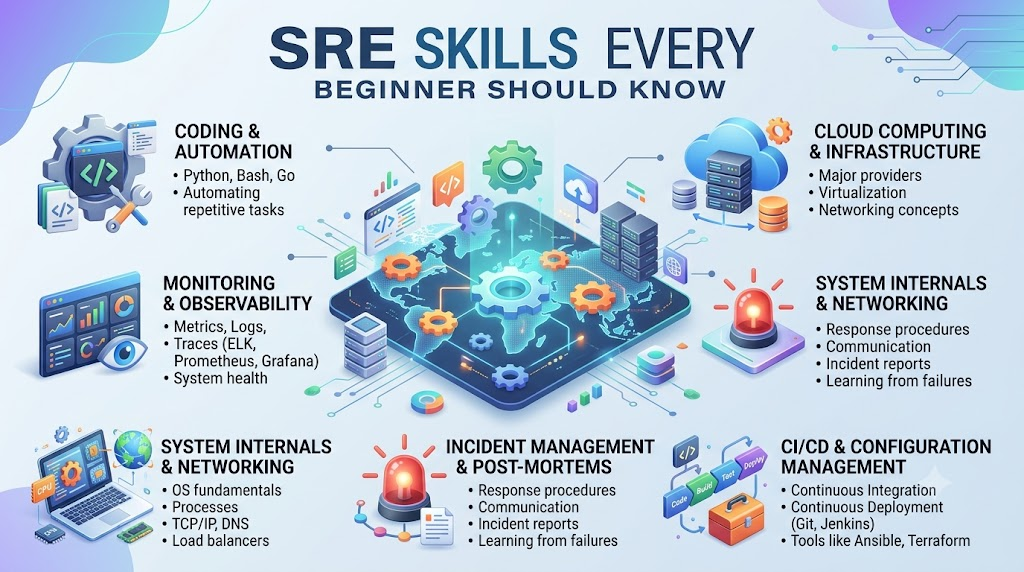
Site Reliability Engineering Training can cover many useful areas. These include monitoring, alerts, cloud systems, automation, and incident response.
An SRE Tutorial can also help beginners learn one topic at a time.
What Can an SRE Course Cover?
A useful SRE Course may include:
- SRE basics
- SLOs and SLIs
- Monitoring
- Observability
- Incident response
- Cloud systems
- Kubernetes
- Automation
- Capacity planning
- Reliability testing
Learners can build skills step by step. They can also practice with simple system examples.
Where SRE Certification Fits
SRE Certification can help learners study reliability topics in a planned way.
A Site Reliability Engineering Certification path may also help learners review key concepts.
Still, certificates are only one part of learning. Practical skills also matter when working with real systems.
SRE Best Practices for Better Reliability
Good SRE work follows simple habits. Teams should focus on users and system health.
They should also learn from failures instead of only fixing symptoms.
Here are some useful practices:
- Set clear reliability goals.
- Track useful service signals.
- Create focused alerts.
- Review incidents after they end.
- Automate repeat work.
- Test system changes.
- Plan for traffic growth.
- Reduce manual tasks.
- Keep system notes clear.
These habits can help teams improve over time.
SRE Training in India can be useful for learners who want to build these skills. SRESchool.in can also help learners explore SRE topics in a structured way.
Frequently Asked Questions About SRESchool
1. What is SRE?
SRE means Site Reliability Engineering. It combines software skills with system operations. SRE teams work to keep services reliable and useful. They use monitoring, automation, testing, and incident response to improve system health.
2. What does an SRE Engineer do?
An SRE Engineer helps keep production systems reliable. They monitor services, handle incidents, improve automation, and fix system problems. They may also work with cloud systems, code, containers, and monitoring tools.
3. What is SRE Training?
SRE Training teaches the main ideas used in reliability work. It may cover SLOs, monitoring, alerts, cloud systems, automation, and incident response. Good training should also give learners chances to practice these skills.
4. What is an SRE Course?
An SRE Course gives learners a planned way to study SRE. It can start with basic ideas and move toward production work. Topics may include monitoring, observability, automation, cloud systems, and incident management.
5. Is SRE Certification useful?
SRE Certification can help learners review important SRE topics. It may also show that a learner studied a defined set of concepts. However, practical skills are also important for real SRE work.
6. What are SRE Tools used for?
SRE Tools help teams monitor and manage systems. They can collect metrics, logs, and traces. Other tools help with alerts, cloud systems, deployment, automation, and incident work.
7. What is an SLI in SRE?
An SLI is a measurement of service performance. It can measure speed, success rate, or another useful signal. Teams use SLIs to understand how well a service works.
8. What is an SLO in SRE?
An SLO is a reliability goal for a service. It tells a team what level of service quality it wants. Teams can compare real results with the SLO and plan improvements.
9. What is observability in SRE?
Observability helps engineers understand what happens inside a system. It uses data such as metrics, logs, and traces. This data can help teams find the cause of complex problems.
10. Can beginners learn SRE?
Yes, beginners can learn SRE step by step. They can start with basic system and cloud ideas. Then they can learn monitoring, automation, incidents, and reliability goals through practice.
Final Thoughts
SRE helps teams build and run reliable systems. Monitoring plays a key role in this work.
It helps teams find problems and understand system health. SLOs give teams clear reliability goals.
Observability gives engineers more clues during hard incidents. Automation can also reduce repeated manual work.
Learning these skills takes practice. A clear SRE Course, useful SRE Tutorial resources, and hands-on work can help learners grow. SRESchool.in provides learning content around these core SRE topics.
Leave a Reply